
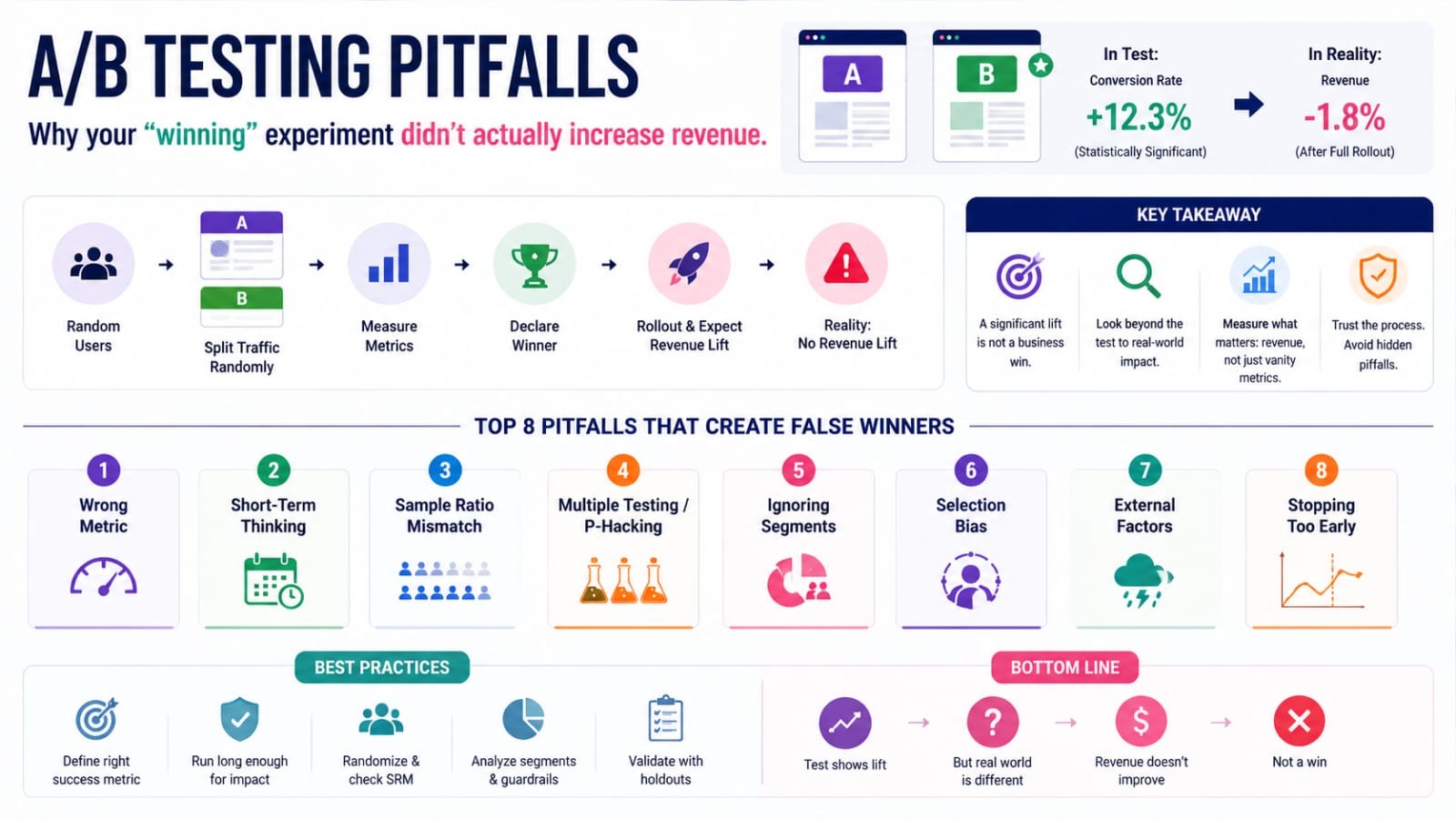
A/B testing is often treated like a magic wand in the world of product, marketing, and growth. You run an experiment, compare two versions, declare a winner, and move forward with confidence. It feels scientific. Clean. Objective.
But here’s the uncomfortable truth: sometimes your “winning” experiment didn’t actually win anything meaningful at all—especially when it comes to revenue.
If you’ve ever celebrated an uplift in click-through rates, conversions, or engagement, only to see your revenue stay flat (or worse, drop), you’re not alone. A/B testing is powerful, but it’s also easy to misuse. And when it’s misused, it can quietly lead you in the wrong direction.
Let’s unpack some of the most common pitfalls that cause misleading results—and what you can do to avoid them.
1. You Optimized the Wrong Metric
This is probably the most common trap.
Let’s say you test two versions of a checkout page. Version B increases the number of people who click the “Buy Now” button by 12%. That sounds like a clear win, right?
Not necessarily.
What if those extra clicks don’t translate into completed purchases? Or worse—what if they lead to lower-value purchases?
When you optimize for surface-level metrics like clicks or sign-ups, you risk missing the bigger picture. Revenue is influenced by multiple steps in the funnel, not just one.
What to do instead:
Always tie your experiment to a meaningful business outcome. If revenue is the goal, track revenue per user, average order value, or lifetime value—not just intermediate steps.
2. Your Sample Size Was Too Small
It’s tempting to call a winner early, especially when the numbers start looking promising. But small sample sizes can produce misleading results due to random variation.
In simple terms: sometimes what looks like a “lift” is just noise.
A test might show a 10% increase after a few hundred users, but that difference can disappear—or even reverse—when you scale up.
What to do instead:
Be patient. Calculate the required sample size before starting the test, and stick to it. Ending tests too early is one of the fastest ways to fool yourself.
3. You Stopped the Test Too Soon
This is closely related to sample size, but it deserves its own spotlight.
Many teams monitor their experiments daily. The moment they see a statistically significant result, they stop the test and declare a winner.
The problem? Early results are often unstable.
User behavior can fluctuate based on the day of the week, time of day, or even external factors like holidays or promotions. If you stop too early, you might capture a temporary spike instead of a real trend.
What to do instead:
Run tests for a full business cycle—usually at least one to two weeks. This helps account for natural variation in user behavior.
4. Novelty Effects Skewed Your Results
Humans are naturally drawn to new things. When users see a new design, feature, or layout, they may engage with it more simply because it’s different—not because it’s better.
This is called the novelty effect.
For example, a redesigned homepage might initially boost engagement because users are curious. But after a few weeks, that curiosity fades—and so does the performance.
What to do instead:
Let your tests run long enough to see whether the effect persists. If possible, monitor performance even after implementing the “winning” version.
5. You Ignored Segmentation
Not all users behave the same way.
An experiment might perform well overall but have very different effects across segments. For instance, it could boost conversions for new users but hurt returning customers—or vice versa.
If you only look at aggregate data, you might miss these hidden trade-offs.
What to do instead:
Break down your results by key segments: new vs. returning users, mobile vs. desktop, geography, and so on. Sometimes the “winner” isn’t universally better—it’s just better for a specific group.
6. You Didn’t Account for External Factors
Experiments don’t happen in a vacuum.
Imagine running a pricing test during a major sale, or testing a new feature right after a marketing campaign goes live. External factors like promotions, seasonality, or traffic spikes can heavily influence results.
If you’re not careful, you might attribute changes to your experiment when they’re actually caused by something else.
What to do instead:
Keep a close eye on what else is happening during your test. If possible, avoid running experiments during unusual periods—or at least document those conditions when analyzing results.
7. Statistical Significance Was Misunderstood
Statistical significance is often treated as a green light: once you hit 95%, you’re good to go.
But that’s an oversimplification.
A statistically significant result doesn’t guarantee that the effect is large, meaningful, or even repeatable. It just means the observed difference is unlikely to be due to chance under certain assumptions.
You can have a statistically significant result that barely moves the needle on revenue—or one that doesn’t hold up over time.
What to do instead:
Look beyond significance. Consider effect size, confidence intervals, and practical impact. Ask yourself: “Even if this result is real, does it matter?”
8. Multiple Testing Without Proper Controls
If you run a lot of experiments—or test multiple variations at once—you increase the chances of finding a “winner” purely by luck.
This is known as the multiple comparisons problem.
The more tests you run, the more likely you are to get false positives. Without proper controls, you might end up implementing changes that don’t actually work.
What to do instead:
Adjust for multiple testing when necessary, and avoid running too many overlapping experiments on the same users. Be disciplined about how you design and interpret tests.
9. You Focused on Short-Term Gains
Some experiments improve short-term metrics at the expense of long-term value.
For example, a pop-up offering a discount might increase immediate conversions—but reduce overall revenue by encouraging users to wait for deals. Or a more aggressive upsell might boost average order value but harm customer trust.
Short-term wins can hide long-term losses.
What to do instead:
Whenever possible, track longer-term outcomes like retention, repeat purchases, or customer lifetime value. A true “win” should hold up over time.
10. You Didn’t Validate the Results After Launch
Even after declaring a winner, the job isn’t done.
Sometimes an experiment performs well during the test but fails to deliver the same results when rolled out to 100% of users. This can happen due to scaling effects, changes in user behavior, or interactions with other features.
What to do instead:
Monitor performance after launch. Treat implementation as part of the experiment, not the end of it.
The Bigger Picture: A/B Testing Is a Tool, Not a Truth Machine
A/B testing is incredibly useful—but it’s not foolproof.
It doesn’t replace critical thinking, and it doesn’t guarantee correct decisions. At its core, it’s just a method for reducing uncertainty—not eliminating it.
The real danger isn’t running experiments—it’s trusting them blindly.
A Simpler Way to Think About It
Instead of asking, “Which version won?” try asking:
What did we actually learn?
Does this result make sense given what we know about our users?
How confident are we that this will improve revenue—not just metrics?
When you shift your mindset from “winning tests” to “learning from experiments,” you start making better decisions.
Final Thoughts
If your “winning” A/B test didn’t increase revenue, it doesn’t mean A/B testing is broken. It just means something in the process went wrong—or wasn’t fully understood.
And that’s okay.
Every misleading result is still a learning opportunity. The key is to dig deeper, question assumptions, and refine your approach.
Because in the end, the goal isn’t to win tests—it’s to build something that genuinely works.
And that takes more than just a p-value.