
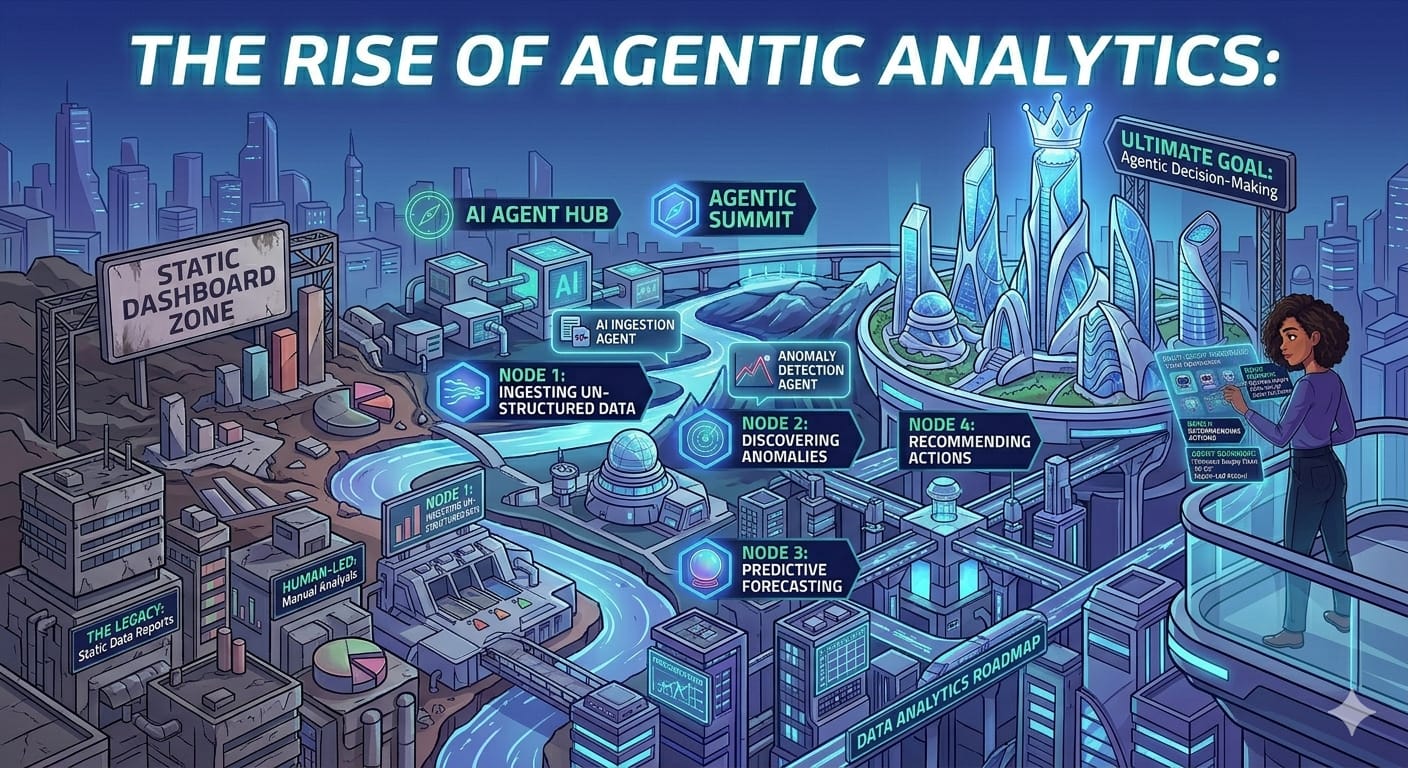
For years, dashboards have been the backbone of business intelligence. They sit at the center of decision-making—colorful charts, neatly organized KPIs, and filters that promise clarity. But let’s be honest: dashboards don’t think. They don’t act. They just sit there, waiting for someone to interpret them.
That’s starting to change.
We’re entering the era of agentic analytics—a shift where AI doesn’t just present data, but actively works with it. Instead of static dashboards, organizations are increasingly relying on intelligent agents that can analyze, reason, and even take action. This isn’t a minor upgrade. It’s a fundamental shift in how decisions get made.
What Is Agentic Analytics?
Agentic analytics refers to systems powered by AI agents that can:
Understand business goals
Explore data autonomously
Generate insights without being prompted step-by-step
Take or recommend actions based on findings
Think of it this way: a dashboard answers questions you already know to ask. An AI agent surfaces insights you didn’t even realize you needed.
The Problem with Static Dashboards
Dashboards have three core limitations that are becoming harder to ignore:
1. They’re Passive
Dashboards don’t alert you unless explicitly configured. If something unusual happens outside predefined rules, it often goes unnoticed.
2. They Require Interpretation
Someone still has to look at the charts, connect the dots, and decide what to do. That creates delays—and room for human bias.
3. They Don’t Scale with Complexity
Modern businesses generate massive, messy, real-time data. Dashboards struggle to keep up without becoming cluttered and overwhelming.
Why AI Agents Are Taking Over
Agentic analytics flips the model from “human asks, system answers” to “system observes, thinks, and suggests.”
Here’s why that matters:
1. From Data to Decisions—Faster
AI agents don’t just visualize data; they interpret it instantly. Instead of spending hours digging through reports, you get direct answers like:
“Sales dropped 12% in Region X due to supply delays.”
“Customer churn is likely to increase next month unless pricing is adjusted.”
That’s not just insight—it’s direction.
2. Continuous Monitoring
Agents work 24/7. They’re always scanning for anomalies, trends, and opportunities. No need to manually check dashboards every morning.
3. Context-Aware Intelligence
Unlike dashboards, agents understand context:
Business goals
Historical trends
External factors
This allows them to deliver insights that are actually relevant, not just statistically interesting.
4. Action-Oriented Outcomes
The biggest leap: agents don’t stop at insight. They can:
Trigger workflows
Send alerts
Recommend or even execute decisions
This closes the gap between analysis and action.
Real-World Use Cases
Agentic analytics is already reshaping industries:
E-commerce: AI agents dynamically adjust pricing and promotions based on demand patterns.
Finance: Systems detect fraud in real-time and take preventive actions instantly.
Marketing: Campaigns are optimized automatically based on performance signals.
Operations: Supply chains are monitored and adjusted proactively to avoid disruptions.
In each case, the system isn’t just reporting—it’s participating.
What This Means for Businesses
This shift changes how teams work:
Analysts move from data pulling to strategy and oversight
Decision cycles shrink dramatically
Organizations become more proactive instead of reactive
But there’s a catch: adopting agentic analytics requires trust in AI systems. Companies need to rethink governance, transparency, and control.
The Future: Humans + Agents
Let’s be clear—AI agents aren’t replacing humans. They’re replacing manual data work.
The future looks like this:
AI agents handle monitoring, analysis, and recommendations
Humans focus on judgment, creativity, and high-level strategy
It’s not about losing control—it’s about gaining leverage.
Final Thought
Static dashboards had a good run. They brought structure to data and made analytics accessible. But they were never the endgame.
Agentic analytics is.
If dashboards were about seeing data, AI agents are about understanding and acting on it. And in a world where speed and insight define success, that difference is everything.
If you’re still relying only on dashboards, you’re not behind—but you are standing still. And right now, everything else is moving fast.