
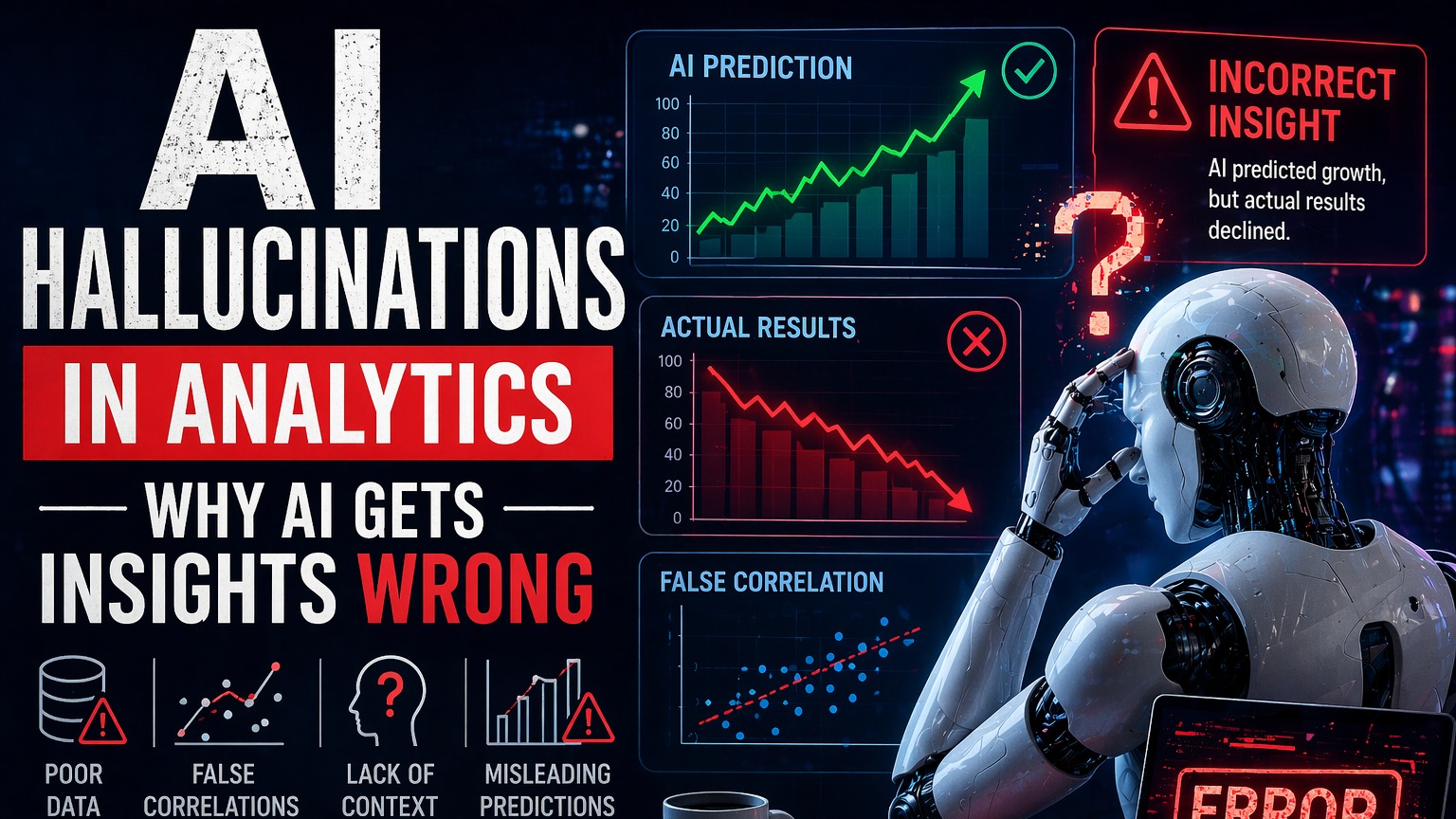
🧠 AI Hallucinations in Analytics: Why AI Gets Insights Wrong
📌 Introduction
Artificial Intelligence (AI) is transforming the world of data analytics. From predicting customer behavior to automating business insights, AI tools like machine learning models and generative AI are widely used across industries.
However, despite its power, AI is not perfect. One of the biggest challenges analysts face today is AI hallucination—a situation where AI generates incorrect, misleading, or completely fabricated insights that appear realistic.
In analytics, this can lead to wrong business decisions, flawed strategies, and financial losses. This blog explores what AI hallucinations are, why they happen, and how to prevent them.
🤖 What Are AI Hallucinations?
AI hallucinations occur when an AI system produces false or inaccurate results that are presented as facts.
In data analytics, this means:
- Incorrect trends
- Misleading predictions
- Fabricated correlations
- Wrong summaries of data
👉 Example:
An AI model might conclude that “sales increased due to social media campaigns” even when there is no real correlation in the dataset.
⚠️ Why AI Gets Insights Wrong
1. 📊 Poor Quality Data
AI models rely heavily on data. If the data is:
- Incomplete
- Biased
- Outdated
➡️ The output will also be inaccurate.
👉 “Garbage in = Garbage out”
2. 🧠 Overfitting and Underfitting
- Overfitting: Model memorizes training data instead of learning patterns
- Underfitting: Model fails to capture important relationships
Both lead to incorrect predictions and insights.
3. 🔍 Lack of Context Understanding
AI does not truly “understand” context like humans.
👉 Example:
AI might misinterpret seasonal sales trends as long-term growth.
4. ⚙️ Model Limitations
No model is 100% accurate.
Some limitations include:
- Limited training data
- Incorrect assumptions
- Simplified algorithms
5. 🧾 Data Bias
If the dataset contains bias, AI will learn and amplify it.
👉 Example:
Biased hiring data → AI recommends unfair hiring decisions
6. 🔄 Misinterpretation of Correlation vs Causation
AI often identifies patterns but cannot always distinguish:
- Correlation (things happening together)
- Causation (one thing causing another)
👉 This leads to misleading insights.
📉 Real-World Impact of AI Hallucinations
AI hallucinations can cause serious problems:
- ❌ Wrong business decisions
- 📉 Financial losses
- ⚖️ Ethical and legal issues
- 📊 Misleading reports and dashboards
👉 Example:
A company may invest heavily in the wrong marketing channel due to incorrect AI insights.
🛡️ How to Prevent AI Hallucinations in Analytics
1. ✅ Use High-Quality Data
- Clean and preprocess data properly
- Remove missing or inconsistent values
2. 🔍 Validate AI Outputs
Never blindly trust AI results.
- Cross-check with actual data
- Use statistical validation
3. 🧠 Human-in-the-Loop
Combine AI with human expertise:
- Analysts verify insights
- Domain experts review outputs
4. 📊 Use Explainable AI (XAI)
Tools like:
- Feature importance
- SHAP values
help understand why AI made a decision.
5. 🔄 Regular Model Monitoring
- Update models frequently
- Retrain with new data
- Detect anomalies early
6. ⚖️ Reduce Bias
- Use diverse datasets
- Apply fairness checks
🚀 Future of AI in Analytics
AI will continue to improve, but hallucinations will remain a challenge.
Future trends include:
- More transparent AI systems
- Better data governance
- Stronger human-AI collaboration
📌 Conclusion
AI is a powerful tool in analytics, but it is not infallible.
AI hallucinations highlight the importance of critical thinking, data quality, and human oversight.
👉 The key takeaway:
Don’t just trust AI—verify it.
By combining AI with human intelligence, organizations can make smarter, more reliable decisions.