
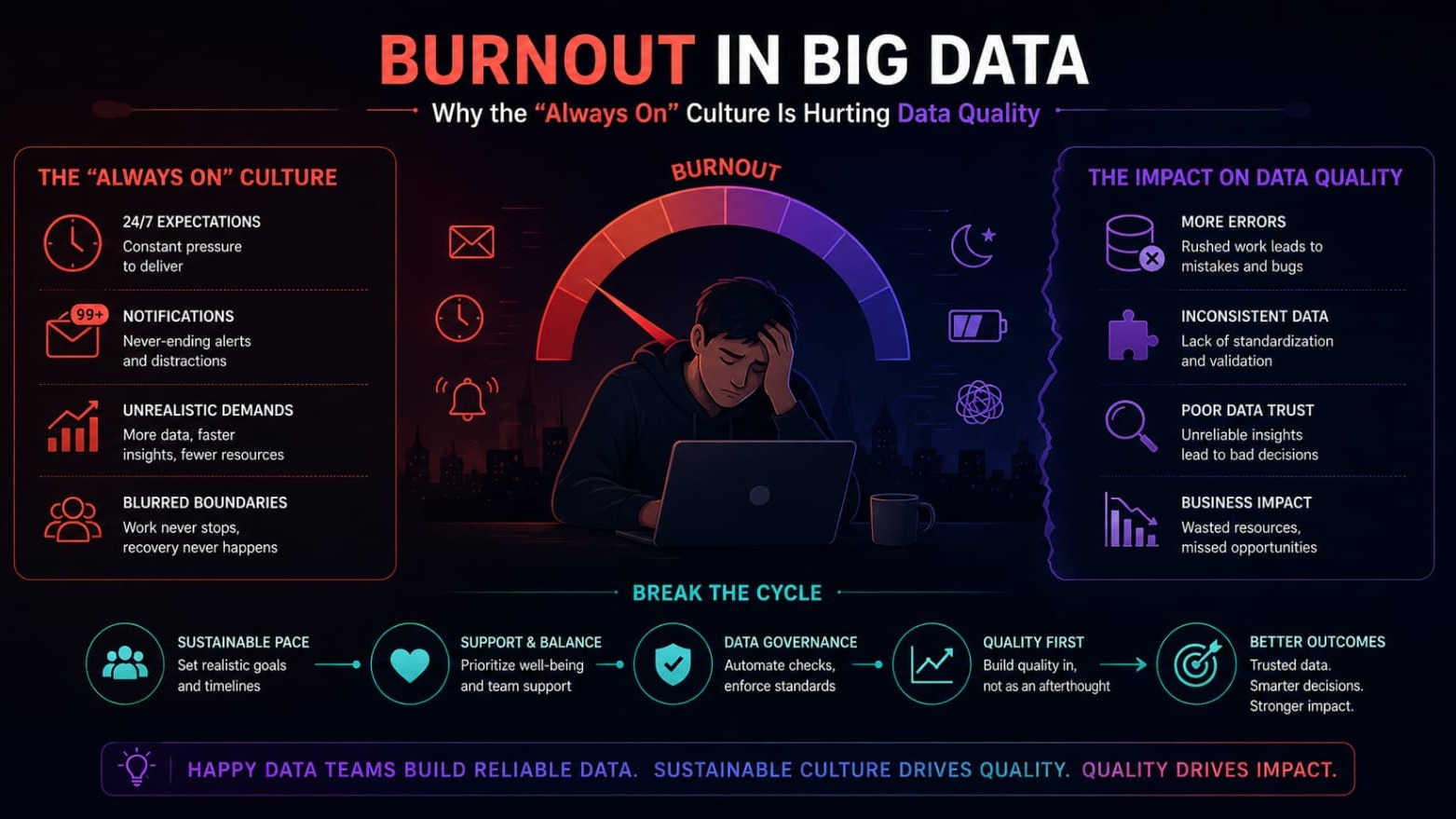
Burnout in Big Data: Why the “Always On” Culture is Hurting Data Quality
It’s 11:47 PM. A data analyst sits in front of a glowing laptop, fixing a dashboard that “must go live by morning.” Slack messages keep popping up, emails keep arriving, and somewhere in the chaos, a small but critical error slips into the dataset. No one notices—until weeks later, when a business decision based on that flawed data goes wrong.
This is not a rare situation. It’s becoming the norm in the world of big data.
The promise of big data was simple: better insights, smarter decisions, and faster growth. But behind the scenes, there’s a growing problem—burnout. The “always on” culture, where professionals are expected to be constantly available, is not just harming people. It’s quietly damaging the quality of data itself.
Let’s understand how.
The Rise of the “Always On” Culture
In today’s digital world, data never sleeps. Systems run 24/7, dashboards update in real time, and businesses expect instant insights. This has created a work environment where data professionals—analysts, engineers, and scientists—are expected to be available all the time.
There’s always a new report to generate, a pipeline to fix, or a stakeholder asking, “Can you just quickly check this?”
What starts as dedication slowly turns into pressure. And pressure, when constant, leads to burnout.
What Does Burnout Look Like in Data Roles?
Burnout isn’t just about feeling tired. It’s deeper than that.
A data professional experiencing burnout might:
- Struggle to focus on tasks
- Make small but frequent mistakes
- Lose interest in problem-solving
- Feel mentally exhausted even after rest
- Rush through work just to “get it done”
In a field where accuracy is everything, even a small mistake can have big consequences.
How Burnout Affects Data Quality
Now let’s connect the dots. How exactly does burnout impact data quality?
1. Increased Errors in Data Processing
When someone is tired or mentally drained, their attention to detail drops. A missing value might go unnoticed. A wrong join in SQL might not be double-checked.
These are not “big mistakes” at first—but they accumulate.
And in big data systems, small errors scale quickly.
2. Poor Decision-Making
Data professionals are not just handling numbers—they’re making decisions about how data is collected, cleaned, and interpreted.
Burnout affects judgment.
A tired analyst might choose a quick fix instead of a correct solution. A data engineer might skip proper testing to meet a deadline. Over time, these shortcuts reduce trust in the data.
3. Lack of Proper Documentation
Good data work requires documentation—clear explanations of datasets, pipelines, and transformations.
But when someone is overwhelmed, documentation becomes the first thing to skip.
“Let’s finish this first, we’ll document later.”
Except “later” rarely comes.
This creates confusion for teams and increases the chances of errors when others use that data.
4. Reduced Innovation and Curiosity
Data work is not just technical—it’s creative. It requires curiosity to ask the right questions and explore patterns.
Burnout kills curiosity.
Instead of exploring insights, people start doing the bare minimum. They stop asking “why” and focus only on “what needs to be delivered.”
This leads to shallow analysis and missed opportunities.
5. Dependency on Automation Without Oversight
Automation is a big part of data systems. But automation still needs human monitoring.
In a burnout culture, people rely too heavily on automated pipelines without checking outputs properly.
“It's running fine” becomes an assumption, not a verified fact.
And when something breaks, it often goes unnoticed for a long time.
The Hidden Cost for Businesses
At first glance, an “always on” culture may seem productive. More hours, more output, faster results.
But the hidden costs are serious:
- Wrong business decisions due to inaccurate data
- Loss of trust in dashboards and reports
- Increased rework, which wastes time and money
- High employee turnover, leading to loss of knowledge
In simple words: bad data is expensive.
And burnout is one of the silent causes behind it.
Why This Problem Is Often Ignored
One reason burnout in data roles goes unnoticed is that the work is mostly invisible.
If a server crashes, everyone sees it.
But if data quality slowly drops, it takes time to notice.
Also, many data professionals don’t speak up. They assume pressure is part of the job. They normalize long hours and constant availability.
Over time, this becomes the culture.
Breaking the “Always On” Cycle
The good news is: this problem can be fixed. But it requires a shift in mindset—from both individuals and organizations.
1. Prioritize Quality Over Speed
Fast results are useful, but correct results are essential.
Teams need to understand that taking a little more time to verify data is better than delivering wrong insights quickly.
2. Set Clear Work Boundaries
Not every message needs an instant reply.
Encouraging fixed work hours and respecting personal time can reduce burnout significantly. When people are well-rested, they work better.
3. Build a Culture of Double-Checking
Make validation a habit.
Simple practices like peer reviews, testing pipelines, and verifying outputs can improve data quality and reduce stress on individuals.
4. Invest in Better Tools
Sometimes burnout comes from repetitive, manual work.
Using better tools for data validation, monitoring, and automation can reduce workload and allow professionals to focus on meaningful tasks.
5. Encourage Open Communication
Teams should feel safe saying:
“I’m overloaded.”
“I need more time.”
“This data might not be reliable.”
Honest communication prevents bigger problems later.
What Individuals Can Do
While organizations play a big role, individuals can also protect themselves.
- Take short breaks during work
- Avoid multitasking too much
- Double-check important work, even if you're in a rush
- Speak up when workload becomes unmanageable
- Remember that your health matters more than deadlines
Working non-stop doesn’t make you more productive—it makes you more error-prone.
A Simple Truth We Often Forget
Data is only as good as the people working on it.
We talk a lot about tools, technologies, and algorithms. But behind every dataset, there’s a human making decisions.
If that human is tired, stressed, and burned out, the data will reflect it.
Final Thoughts
The “always on” culture in big data might look efficient on the surface, but it comes with a hidden cost—burnout and declining data quality.
And here’s the reality:
You can fix a broken pipeline.
You can clean messy data.
But rebuilding trust in data? That’s much harder.
If businesses truly want better insights, they need to take care of the people behind the data.
Because in the end, good data doesn’t come from working more—it comes from working well.