
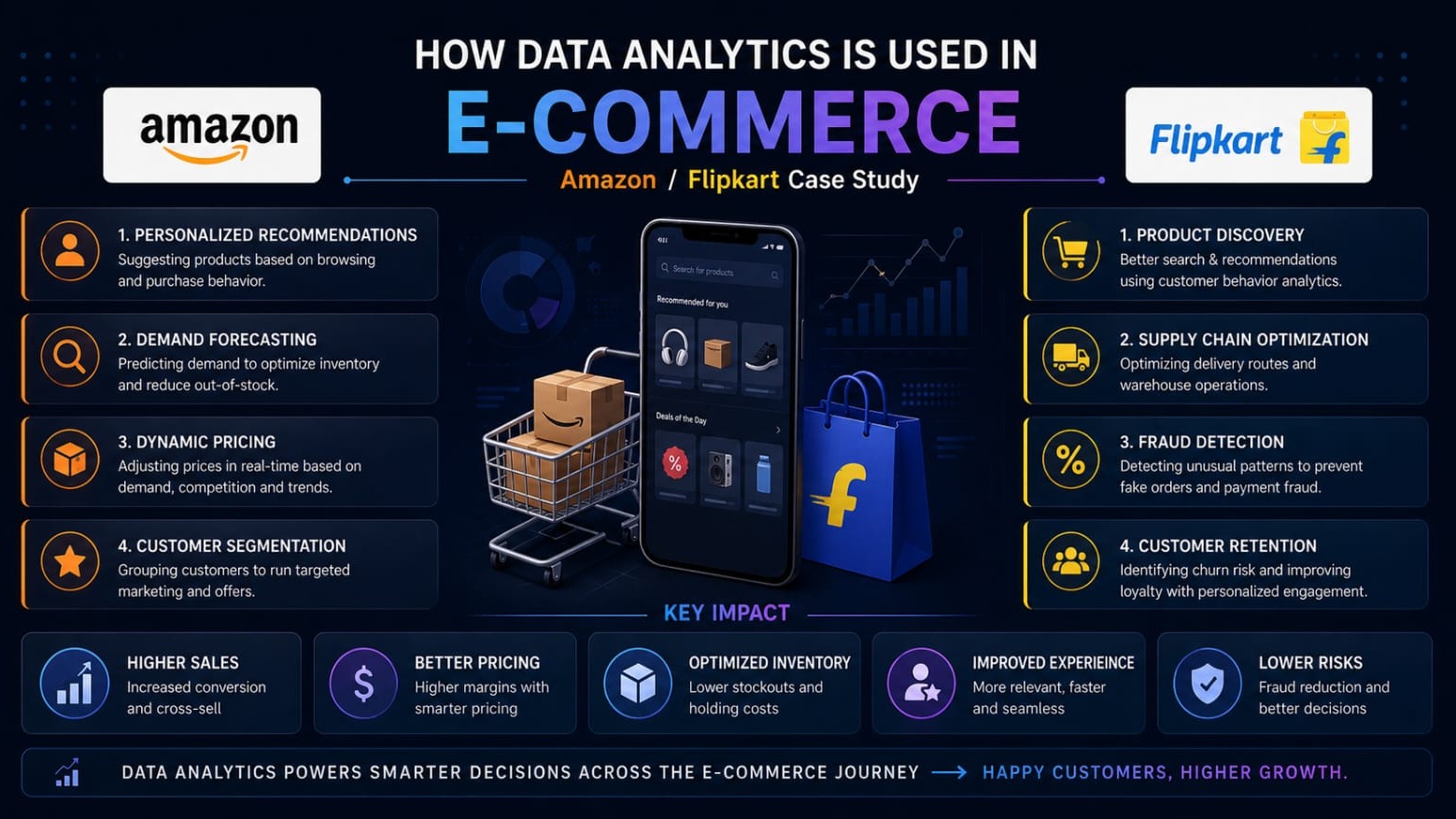
DATA ANALYTICS IN E-COMMERCE
A Deep Dive into Amazon & Flipkart
Case Study Blog
Introduction
E-commerce has completely transformed how the world shops — and at the heart of this transformation is data analytics. Every click, scroll, search, and purchase generates data. Platforms like Amazon and Flipkart don't just collect this data — they turn it into a competitive superpower.
From predicting what you'll buy next to dynamically adjusting prices every few minutes, data analytics is the engine running behind the scenes of modern e-commerce. This blog breaks down exactly how these giants use analytics — and what we can learn from them.
Platform | Daily Active Users (est.) | Daily Transactions (est.) |
|---|---|---|
Amazon (Global) | ~197 million | ~13 million orders/day |
Flipkart (India) | ~10–15 million | ~5 million orders/day (peak) |
Scale matters. At these volumes, even a 1% improvement in prediction accuracy can translate into crores of rupees in revenue.
How Data Analytics Powers E-Commerce
1. Personalization & Product Recommendation
What it means: When Amazon shows "Customers also bought" or Flipkart shows "You may also like" — that's recommendation analytics in action.
Amazon — Collaborative Filtering
Amazon's recommendation engine is often cited as driving ~35% of its total revenue. It uses a technique called item-to-item collaborative filtering:
- Tracks your browsing and purchase history
- Matches your behavior with similar users
- Recommends products that "people like you" have bought
- Also uses real-time session data — if you just searched "running shoes", Amazon instantly adjusts recommendations
Flipkart — Contextual Personalization
Flipkart adapts recommendations based on user location, language preference, price sensitivity, and device type (since 70%+ of its traffic is mobile).
💡 Real Stat McKinsey & Company reports that 35% of Amazon's revenue comes from its recommendation engine. For Flipkart, personalization is especially critical during Big Billion Days sales. |
2. Dynamic Pricing
Ever noticed a product's price change when you refresh a page? That's not a glitch — it's dynamic pricing analytics.
Amazon — Algorithmic Repricing
Amazon changes prices on millions of products up to several times per day. Its pricing algorithm factors in:
- Competitor pricing (scraped in real-time)
- Current demand and stock levels
- Time of day, day of week, seasonal trends
- Your individual purchase history (if you've bought a product before, the price may differ)
Flipkart — Festival & Flash Pricing
Flipkart uses predictive pricing models to plan festival discounts (like Big Billion Days) weeks in advance using historical sales data, and applies real-time surge pricing during flash sales.
Amazon Pricing Factors | Flipkart Pricing Factors |
|---|---|
Competitor price tracking | Festival demand forecasting |
Inventory levels | Seller commission optimization |
Customer purchase history | Regional price sensitivity |
Time-based demand | Mobile-first flash sale triggers |
3. Supply Chain & Inventory Management
Running out of stock on a popular item = lost sales. Overstocking = wasted capital. Analytics helps e-commerce platforms walk this tightrope.
Amazon — Anticipatory Shipping
Amazon holds a patent for "anticipatory shipping" — a system that predicts what you're going to order and pre-ships the product to a nearby warehouse before you've even clicked "Buy".
- Uses order history, wish lists, cart behavior, and search patterns
- Reduces delivery time significantly
- Relies on predictive ML models trained on billions of data points
Flipkart — Smart Fulfillment Centers
Flipkart uses analytics to decide which products to stock in which warehouses (called Smart Fulfillment Centers) based on regional demand patterns. During Big Billion Days, it pre-positions millions of units across India based on predictive models.
4. Customer Segmentation & Lifetime Value
Not all customers are equal. Analytics helps identify who your most valuable customers are — and how to keep them.
RFM Analysis
Both Amazon and Flipkart use variants of RFM (Recency, Frequency, Monetary) analysis to segment customers:
Metric | What It Measures | Business Use |
|---|---|---|
Recency | How recently did the user buy? | Re-engagement campaigns |
Frequency | How often do they buy? | Loyalty programs |
Monetary | How much do they spend? | Premium targeting (Prime) |
Amazon Prime is a masterclass in using analytics for retention. Prime members spend an average of ~2.5x more than non-Prime customers. Analytics identifies which users are at the tipping point of converting to Prime — and targets them with offers.
Flipkart Plus uses a similar model, offering coins-based rewards. Analytics tracks loyalty point usage patterns to predict churn and push re-activation nudges.
5. Fraud Detection & Return Abuse Prevention
E-commerce fraud costs billions globally. Data analytics is the first line of defense.
What analytics detects:
- Unusual login locations or device fingerprints → account takeover fraud
- High-value orders from new accounts with no history → payment fraud
- Patterns of buy-return-buy-return → return abuse
- Fake reviews — NLP models analyze review language patterns to flag suspicious activity
🔍 Amazon's Approach Amazon uses machine learning models that analyze over 1,000 variables per transaction in real-time to flag potential fraud — including typing speed, mouse movement patterns, and session duration. |
Flipkart uses similar ML-based fraud scoring, with additional focus on COD (Cash on Delivery) fraud — a uniquely Indian challenge where buyers receive orders and claim non-delivery.
6. Marketing Analytics & Ad Targeting
Amazon Advertising is now a $50+ billion business — and it's entirely powered by data analytics.
How it works:
- Advertisers bid on keywords and placements
- Amazon's algorithm optimizes ad display based on conversion probability
- Users see ads that match their purchase intent (not just browsing behavior)
- Attribution modeling tracks which ad touchpoint led to a sale
Flipkart — Vernacular & Regional Targeting
Flipkart's analytics goes deeper into India-specific behavior — targeting users by:
- Language preference (Hindi, Tamil, Telugu, etc.)
- Festival calendars by region (Diwali in North India vs. Pongal in South India)
- Income proxies derived from price point behavior and payment method
Amazon vs. Flipkart: Analytics at a Glance
Analytics Area | Amazon | Flipkart |
|---|---|---|
Recommendation | Item-to-item collaborative filtering | Contextual + location-based personalization |
Pricing | Real-time algorithmic repricing (millions/day) | Festival demand forecasting + flash pricing |
Inventory | Anticipatory shipping & pre-positioning | Smart Fulfillment Centers by region |
Customer Analytics | Prime segmentation + CLV modeling | Flipkart Plus + RFM segmentation |
Fraud Detection | 1000+ variable ML models (real-time) | COD fraud detection + return pattern analysis |
Marketing | Amazon Advertising ($50B+ business) | Vernacular + regional festival targeting |
Tools & Technologies Behind the Scenes
These analytics capabilities don't run on spreadsheets. Here's a peek at the tech stack:
Category | Technologies Used |
|---|---|
Data Storage | AWS S3, Redshift, Hadoop HDFS |
Processing | Apache Spark, AWS EMR, Flink |
ML & AI | SageMaker (Amazon), TensorFlow, XGBoost |
Dashboarding | Amazon QuickSight, Tableau, Power BI |
Real-time Analytics | Apache Kafka, Kinesis |
NLP (Reviews/Fraud) | BERT-based models, custom NLP pipelines |
Key Takeaways for Aspiring Data Analysts
So what can we actually learn from how Amazon and Flipkart use analytics?
- Data alone is useless — the value is in the decisions it enables (pricing, stocking, targeting)
- Even simple techniques like RFM analysis can drive multi-crore business decisions
- Real-time data processing is increasingly the standard — batch processing is becoming obsolete
- Domain knowledge matters — Flipkart's success in India comes partly from understanding Indian shopping behavior (COD, vernacular, festivals)
- Visualization and storytelling are crucial — dashboards that stakeholders can actually use create impact
📌 For Your Career If you're learning Python, Pandas, and data visualization — these are precisely the skills that fuel e-commerce analytics. Every recommendation engine starts with a simple dataframe. Every pricing model starts with a scatter plot. Start small, think big. |
Conclusion
Amazon and Flipkart have shown that data analytics is not a "nice to have" — it is the core business function. From the moment you land on their homepage to the second your package arrives, every touchpoint is analytics-driven.
For anyone working in or moving toward data analytics, e-commerce is one of the richest, most practical domains to study. The problems are real, the data is massive, and the impact is measurable in real-time.
The companies that will win tomorrow aren't just the ones with the most products — they're the ones with the best data pipelines.
References & Further Reading
- McKinsey & Company — The value of recommendation engines in retail
- Amazon Annual Reports (2022–2024)
- Flipkart Tech Blog — engineering.flipkart.com
- AWS Blog — Machine Learning at Amazon Scale
- Harvard Business Review — How Amazon Uses Analytics
- NASSCOM Reports — E-commerce Analytics in India