
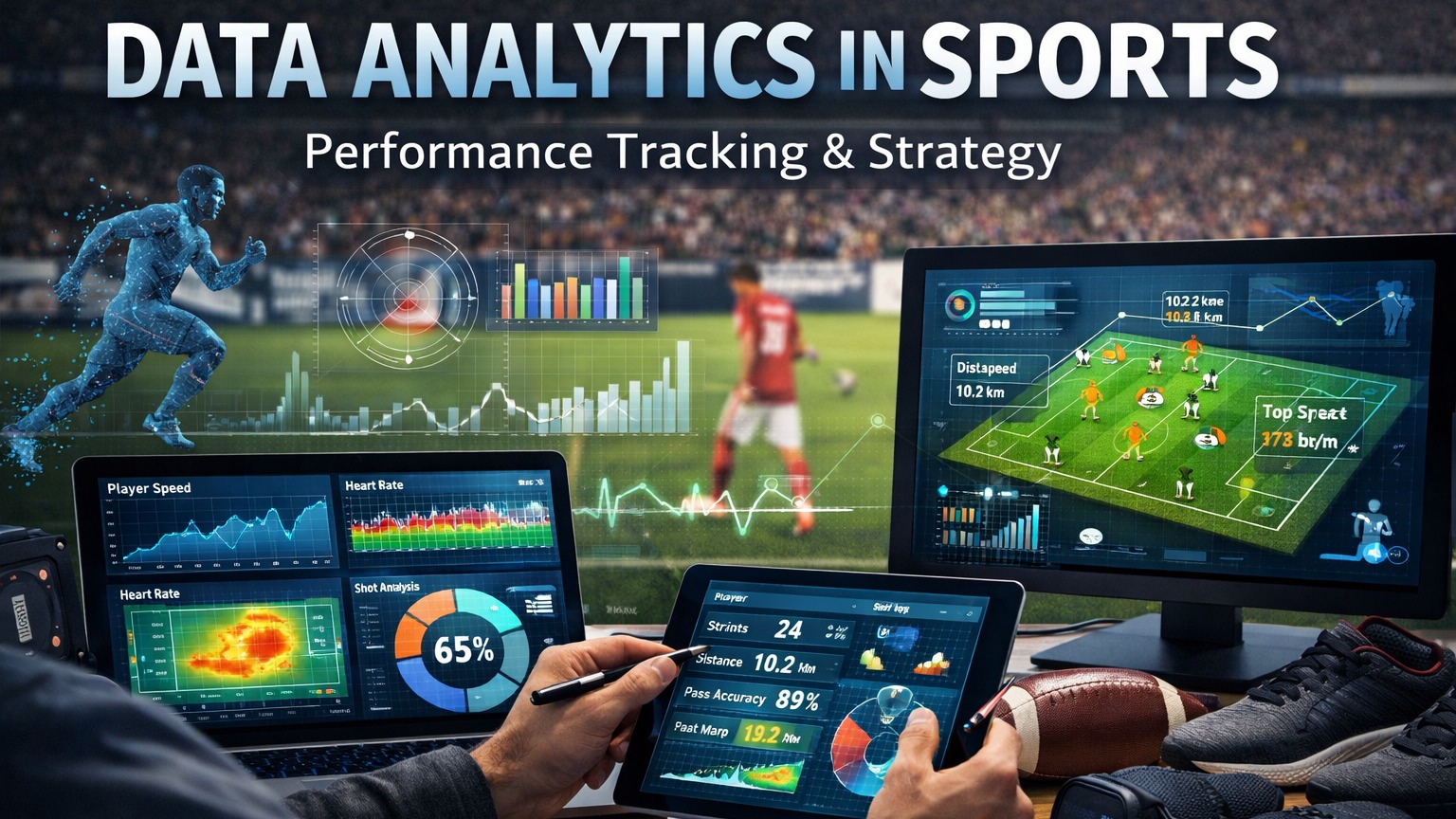
DATA ANALYTICS IN SPORTS
Performance Tracking & Strategy
How Numbers Are Revolutionizing the Way We Play, Coach, and Win
April 2026 • Sports & Technology • Data Analytics
Remember when sports strategy meant a coach drawing X's and O's on a whiteboard? Those days are quickly fading. Today, elite sports organizations run on data — mountains of it. From GPS sensors in a footballer's boots to AI models predicting injury risk before a player even feels pain, data analytics has completely transformed how the sporting world operates.
This blog breaks down how data analytics is being used in sports for performance tracking and strategy — and why it's not just a tech trend but the new competitive edge.
1. What Is Sports Analytics?
Sports analytics is the practice of collecting, processing, and analyzing data related to athletes, teams, games, and opponents to make better decisions. It sits at the intersection of data science, statistics, and domain knowledge about the sport itself.
There are two main branches:
On-field analytics — player performance, movement patterns, physical load, biomechanics
Off-field analytics — ticket pricing, fan engagement, broadcast strategy, recruitment
We'll focus on on-field analytics in this blog — the stuff that directly impacts results on the pitch, court, or field.
2. Performance Tracking: What Gets Measured?
Modern sports generate an extraordinary volume of data during every training session and match. Here's a breakdown of what teams typically track:
2.1 Physical & Biometric Data
Wearable sensors embedded in training kits, GPS vests, and heart rate monitors capture real-time physical data throughout every session.
Metric
Tool Used
Why It Matters
Distance covered
GPS tracker
Measures workload & fitness levels
Sprint speed (km/h)
Optical tracking
Identifies pace and recovery capacity
Heart rate zones
HRM wearables
Monitors cardio exertion and fatigue
Acceleration/Deceleration
IMU sensors
Detects explosive movement & injury risk
Sleep & recovery
Smart rings/bands
Ensures optimal readiness for match day
2.2 Technical & Tactical Data
Beyond physical fitness, analytics captures technical actions — every pass, shot, tackle, and positioning decision is logged and analyzed.
Pass accuracy and completion rates by zone
Shot on target percentage and xG (Expected Goals) in football
Ball possession percentage and transition speed
Heat maps showing where a player spends most of their time
Defensive pressure index and pressing triggers
2.3 Video & Computer Vision
AI-powered video analysis tools like StatsBomb, Hudl, and Catapult Vision track player movements frame-by-frame across every second of a match. Skeleton tracking and pose estimation now let analysts understand body mechanics in ways that were impossible even five years ago.
Real World Example — FC Barcelona
FC Barcelona's sports science team uses a combination of GPS tracking, heart rate variability data, and AI video analysis to manage the training load of every player. Decisions on whether a player starts, comes off the bench, or rests entirely are driven by data dashboards — not just the coach's instinct.
3. Strategy: How Data Wins Games
Tracking is just one side of the coin. The bigger value of analytics lies in how teams use that data to build game strategies, scout opponents, and make in-game decisions.
3.1 Pre-Match Opponent Analysis
Before a match, data analysts build detailed profiles of the opposing team — identifying patterns, tendencies, and weaknesses. This includes:
Identifying which flank an opponent attacks most frequently
Which set-piece routines they use and their success rate
Individual player tendencies (e.g., a striker who always cuts inside)
Pressing triggers — when does the opponent lose possession most often?
Teams like Liverpool FC and the Golden State Warriors have entire analytics departments dedicated to opponent modelling. Their pre-match briefings are as data-dense as a corporate strategy deck.
3.2 In-Game Decision Making
Live analytics dashboards are now common on the sidelines. Coaches receive real-time alerts when a player's sprint speed drops by a certain percentage — a signal of fatigue. Substitutions that once relied on gut feeling are now backed by data.
Sport
In-Game Data Point
Decision It Drives
Football
Player fatigue index
Substitution timing
Basketball
Shot quality (shot chart)
Play call adjustment
Cricket
Bowling economy trends
Bowling change / field setting
Tennis
First serve % by zone
Serve strategy mid-set
Baseball
Pitcher arm load (pitches)
Pitcher substitution
3.3 Recruitment & Transfer Strategy
Gone are the days of scouts exclusively relying on eye tests. Data has redefined player recruitment across every major sport. The concept of 'Moneyball' — famously used by the Oakland Athletics baseball team — showed the world that undervalued players identified through statistics could build a winning team at a fraction of the cost of star players.
Today, football clubs use platforms like Wyscout, InStat, and StatsBomb to screen thousands of players globally, filtering by metrics like pressing intensity, progressive passes per 90 minutes, or expected assists (xA).
Moneyball Effect in Modern Football
Brentford FC in the English Premier League became a landmark case study. Using advanced data scouting, they consistently identify undervalued players from smaller leagues who fit specific statistical profiles. Their analytics-first recruitment model helped them punch far above their budget and gain promotion to the Premier League.
4. Key Technologies Powering Sports Analytics
Several technologies come together to make modern sports analytics possible:
Technology
Application in Sports
GPS & IMU Wearables
Real-time location, speed, acceleration tracking
Optical Tracking (cameras)
Ball & player movement across the full pitch
Computer Vision / AI
Pose estimation, pattern recognition in video
IoT Sensors
Smart balls, smart courts, load monitoring
Machine Learning Models
Injury prediction, performance forecasting
Data Dashboards (Tableau, Power BI)
Visualization for coaching staff and analysts
Cloud Platforms (AWS, Azure)
High-speed storage and processing of match data
5. Injury Prevention: The Most Valuable Use Case
If there's one area where sports analytics provides the clearest ROI, it's injury prevention. A single key player's long-term injury can derail an entire season — financially and competitively.
Teams now use machine learning models trained on thousands of data points to predict injury risk before the athlete feels anything. Key inputs include:
Cumulative distance covered over the last 7 days
Spikes in high-speed running volume
Heart rate variability (HRV) trends over multiple mornings
Sleep quality scores from wearables
Muscle load imbalance detected via GPS
When the model flags a player as 'high risk', the medical and coaching staff can proactively reduce training load, preventing injuries before they happen. Teams using these systems report 20–40% reductions in soft tissue injuries — massive savings in both performance and transfer market value.
6. Sport-Specific Snapshots
Cricket
The IPL and international cricket boards now use ball-tracking technology (Hawk-Eye), wagon wheels, wagon plots, and pitch maps to analyze bowler variations and batting weaknesses. Teams build specific game plans for each opposition batsman based on their dismissal history data.
Basketball (NBA)
The NBA's Second Spectrum system tracks every player 25 times per second using six cameras per arena. This generates data on shot quality, defensive positioning, spacing, and off-ball movement — giving coaches insights that were previously invisible.
Formula 1
Perhaps no sport is more data-intensive than F1. Teams process over 100GB of data per race weekend. Every tire compound choice, pit stop window, fuel load, and aerodynamic setting is driven by predictive analytics models running in real time during the race.
Football (Soccer)
Expected Goals (xG), Expected Assists (xA), PPDA (Passes Allowed Per Defensive Action), and progressive passes are now standard metrics discussed in mainstream football commentary. Clubs at every level — from the Champions League to the Championship — use analytics platforms to evaluate performance.
7. Challenges in Sports Analytics
As powerful as sports analytics has become, it's not without its limitations and criticisms:
Data overload: Coaches and analysts can be overwhelmed by the sheer volume of data if insights aren't well-filtered
Human context: Numbers don't capture team morale, player psychology, or in-game momentum shifts
Cost barriers: Advanced analytics infrastructure remains expensive, giving richer clubs a further advantage
Over-reliance risk: Pure data-driven decisions can sometimes undervalue intangible qualities — leadership, experience, clutch performance
Privacy concerns: Biometric data collection raises important ethical and consent questions for athletes
The best sports organizations find the balance — using data to inform decisions, while still trusting experienced coaches and athletes to apply human judgment in the moment.
8. The Future of Sports Analytics
The field is evolving rapidly. Here's what's on the horizon:
Real-time AI coaching assistants that suggest tactical changes mid-game via earpieces
Generative AI tools that create personalized training plans based on an athlete's unique biometric profile
Augmented Reality (AR) overlays in stadiums that display live player stats to fans
Digital twin technology — virtual replicas of athletes used to simulate injury recovery and training loads
Fan analytics platforms that personalize broadcast experiences based on viewer preferences
We're moving toward a future where every decision in sport — from what a player eats for breakfast to how many minutes they play — will have a data layer informing it.
Conclusion
Data analytics has permanently changed the DNA of competitive sport. It has democratized access to strategic insight (a club with a smart analytics team can compete with clubs 10x their budget), extended athlete careers, and made the game sharper, smarter, and more scientific than ever before.
But here's the thing — the data only tells part of the story. The magic still happens when a great athlete, driven by passion and competitive fire, takes the insight from the numbers and turns it into performance under pressure. Analytics doesn't replace sport. It amplifies it.
For students and professionals in data analytics, sports is one of the most exciting and fast-growing domains to build a career in. The combination of rich real-time data, high stakes decision-making, and passionate audiences makes it a uniquely rewarding space to apply your skills.
Takeaway
Data analytics in sports isn't just about tracking what happened — it's about predicting what will happen, preventing what shouldn't happen, and building strategies that give athletes and teams their best possible chance of winning.
Written for educational and professional development purposes • April 2026