
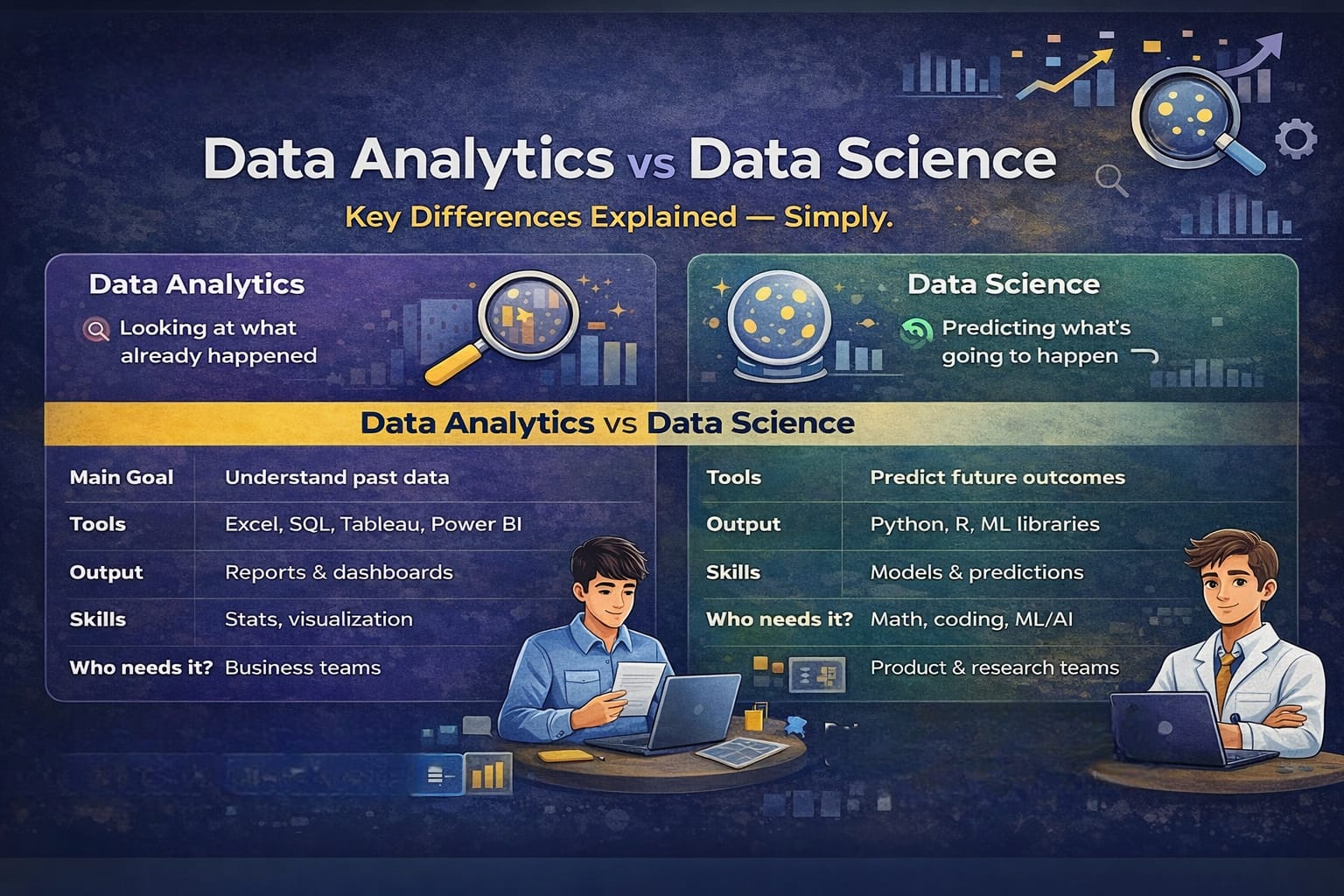
Data Analytics vs Data Science
Key Differences Explained — Simply.
5 min read • Beginner-friendly
Everyone's talking about data careers. But when you look at job listings, two titles keep showing up: Data Analyst and Data Scientist. Sounds similar, right? They're actually pretty different.
Let's break it down — no jargon, no fluff.
The Simple Way to Think About It
🔍 Data Analytics = Looking at what already happened
🔮 Data Science = Predicting what's going to happen
Think of it like this: a data analyst is like a detective — piecing together clues from the past. A data scientist is more like a forecaster — using patterns to predict the future.
What Does a Data Analyst Actually Do?
A data analyst's job is to make sense of existing data and help businesses make better decisions.
Day-to-day work usually looks like:
- Pulling data from databases using SQL
- Building dashboards in tools like Power BI or Tableau
- Spotting trends and writing reports
- Answering questions like "Why did sales drop last month?"
💼 Think: Flipkart analyst tracking which products sell most during Diwali.
What Does a Data Scientist Actually Do?
A data scientist builds systems that can learn from data and make predictions — often automatically.
Their typical work:
- Writing code in Python or R to build ML models
- Training algorithms to predict outcomes (churn, prices, fraud)
- Working with unstructured data like text, images, audio
- Answering questions like "Which users are likely to cancel next month?"
🤖 Think: Swiggy's model predicting your delivery time before you even order.
Side-by-Side Comparison
Data Analytics | Data Science | |
Main Goal | Understand past data | Predict future outcomes |
Tools | Excel, SQL, Tableau, Power BI | Python, R, ML libraries |
Output | Reports & dashboards | Models & predictions |
Skills | Stats, visualization | Math, coding, ML/AI |
Who needs it? | Business teams | Product & research teams |
Which One Should You Learn First?
Honestly? Start with Data Analytics.
- Lower barrier to entry — Excel and SQL are beginner-friendly
- Faster to get job-ready (3–6 months vs 1–2 years for DS)
- Strong business demand — every company needs analysts
- Analytics is actually the foundation for data science anyway
✅ Master analytics first → then level up to data science if you want.
Skills Required
Data Analytics Skills:
- Excel
- SQL
- Power BI / Tableau
- Basic Python
Data Science Skills:
- Python / R
- Machine Learning
- Statistics
- Data Engineering basics
Career Opportunities
Data Analytics Roles:
- Data Analyst
- Business Analyst
- Reporting Analyst
Data Science Roles:
- Data Scientist
- Machine Learning Engineer
- AI Engineer
Salary Comparison (India)
- Data Analyst: ₹3–8 LPA (Beginner)
- Data Scientist: ₹6–15 LPA (Beginner)
The Overlap (It's Real)
Here's the honest truth — the line between the two is getting blurry. Many data analysts write Python now. Many data scientists spend half their time doing... analytics. Don't stress the label too much.
Focus on building skills: SQL, Python, statistics, storytelling with data. The title will follow.
TL;DR
- Analytics = past data → insights → decisions
- Data Science = data + code + ML → predictions → automation
- Both are valuable. Both are in demand.
- Start with analytics. Go deeper when you're ready.
Conclusion
Both Data Analytics and Data Science are excellent career options in 2026. Your choice depends on your interest, skills, and career goals.
Start with Data Analytics if you are a beginner, and gradually move towards Data Science for advanced opportunities.
— Written for curious humans, not textbooks.