
If you’ve ever tried stepping into the world of data, you’ve probably felt this quiet confusion creep in.
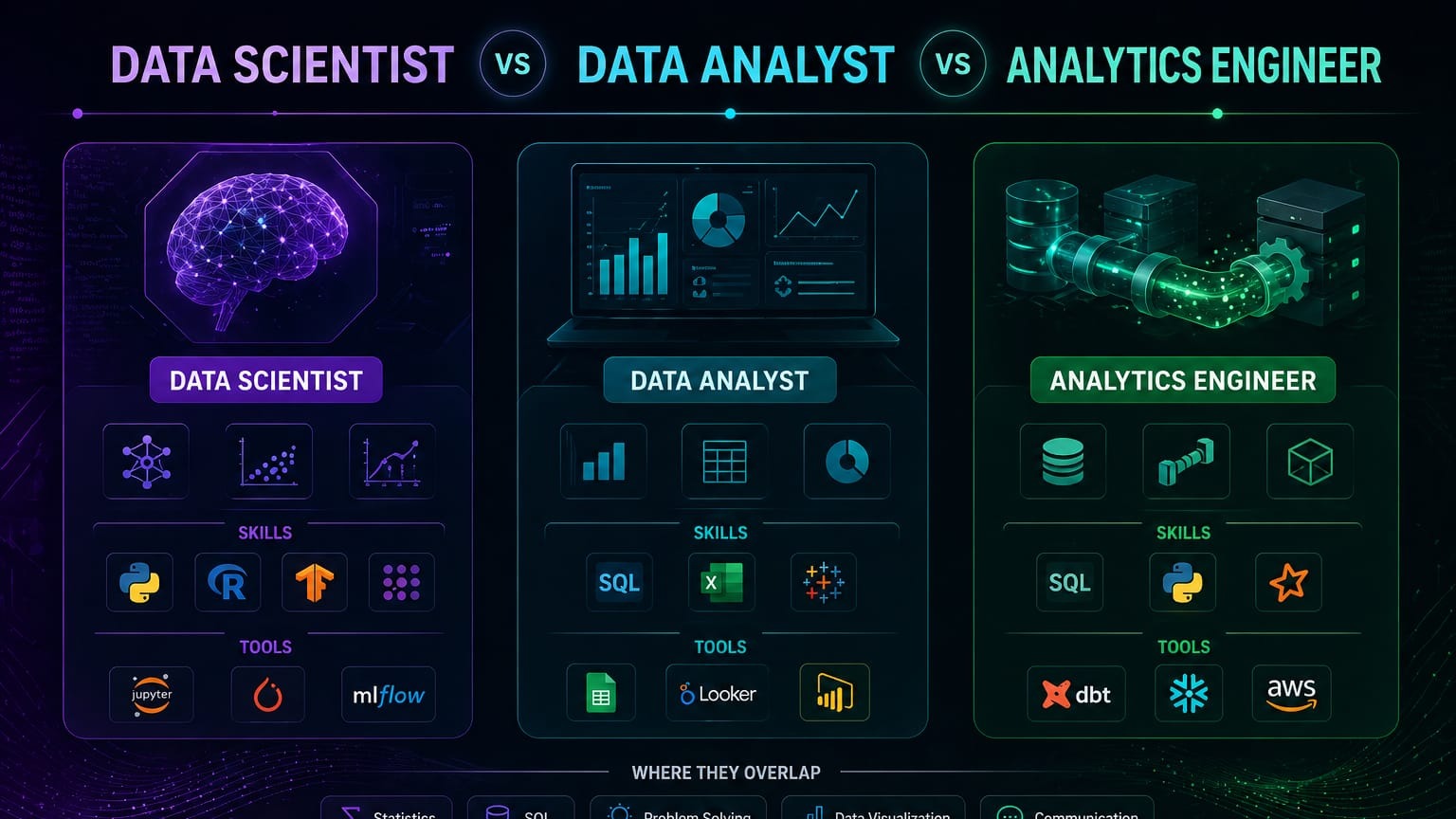
You search for “careers in data,” and suddenly you’re hit with titles that sound almost identical: Data Scientist, Data Analyst, Analytics Engineer. Different names, similar skills, overlapping tools — it’s enough to make anyone pause and wonder, am I even choosing the right path?
Let’s slow this down and make sense of it — not like a textbook, but like real work happening inside a real company.
The Data Analyst: Making Sense of What Already Happened
Imagine a company just finished a big marketing campaign. Money was spent, ads were run, customers clicked, some bought — and now everyone is asking the same question:
“So… did it actually work?”
This is where the Data Analyst steps in.
They don’t build complex AI models or design infrastructure. Their strength lies in clarity. They take messy, scattered data and turn it into something understandable. A good analyst doesn’t just present numbers — they tell you what those numbers are trying to say.
On a typical day, they might clean datasets, write SQL queries, build dashboards, and sit with business teams to explain trends. But the real value they bring isn’t technical — it’s interpretational. They help companies avoid guessing.
A strong Data Analyst feels less like a coder and more like a detective who knows how to explain the case to everyone else.
The Data Scientist: Looking Ahead Instead of Behind
Now shift the situation slightly.
Instead of asking, “Did the campaign work?”, the company asks something more ambitious:
“Which customers are most likely to buy next time?”
That’s not a reporting question anymore. That’s a prediction problem — and that’s where the Data Scientist comes in.
Data Scientists work in the space between mathematics and real-world decisions. They build models that try to capture patterns in data and use those patterns to make educated guesses about the future.
But here’s the part people don’t tell you: a large portion of their work still involves cleaning data, experimenting, and failing quietly before anything useful appears. The “AI magic” is real — but it sits on top of a lot of groundwork.
What separates a Data Scientist isn’t just coding skill. It’s the ability to think in terms of uncertainty, probabilities, and trade-offs. They’re not just answering questions — they’re shaping decisions before they’re made.
The Analytics Engineer: The Quiet Architect
Now imagine something breaks.
The numbers don’t match across dashboards. The same metric shows two different values depending on where you look. Analysts are confused, scientists don’t trust the data, and decisions start slowing down.
This is the kind of chaos an Analytics Engineer is hired to prevent.
While analysts and scientists focus on using data, Analytics Engineers focus on preparing it — clean, structured, reliable, and ready to be used at scale.
They design datasets, define consistent metrics, and build transformations so that when someone asks, “What are our monthly active users?”, everyone is looking at the same answer.
It’s not flashy work. There’s no dramatic “prediction moment.” But without it, everything else collapses.
If data is a product, Analytics Engineers are the ones making sure it’s usable.
Where People Get It Wrong
Most beginners fixate on titles instead of understanding the nature of the work.
“Data Scientist” sounds the most impressive, so it becomes the default goal. But that’s often a mistake.
Each of these roles requires a different way of thinking:
Analysts focus on clarity and communication
Scientists focus on modeling and uncertainty
Engineers focus on structure and reliability
If you choose based on hype instead of alignment, you’ll struggle — not because you’re not capable, but because the work doesn’t match how you think.
So, Which One Should You Choose?
Instead of asking which role is “better,” ask yourself a more honest question:
What kind of problems do I enjoy sitting with for hours?
Do you like explaining things in simple terms? You’ll thrive as an analyst.
Do you enjoy math and experimentation, even when results aren’t immediate? That’s a scientist’s mindset.
Do you care about systems, organization, and making things work smoothly behind the scenes? That’s where analytics engineering fits.
There’s no locked door here. People move between these roles all the time. In fact, many great Data Scientists started as Analysts, and many Analysts grow into Engineers once they understand data more deeply.
Final Thought
The data world isn’t divided into rigid boxes — it’s a spectrum of responsibilities.
What matters isn’t what your title says. What matters is whether you can take messy information and turn it into something useful.
That’s the real skill. The rest is just naming.
So don’t rush to pick the “best” role. Pick the one that feels natural to how you think — and build from there.