
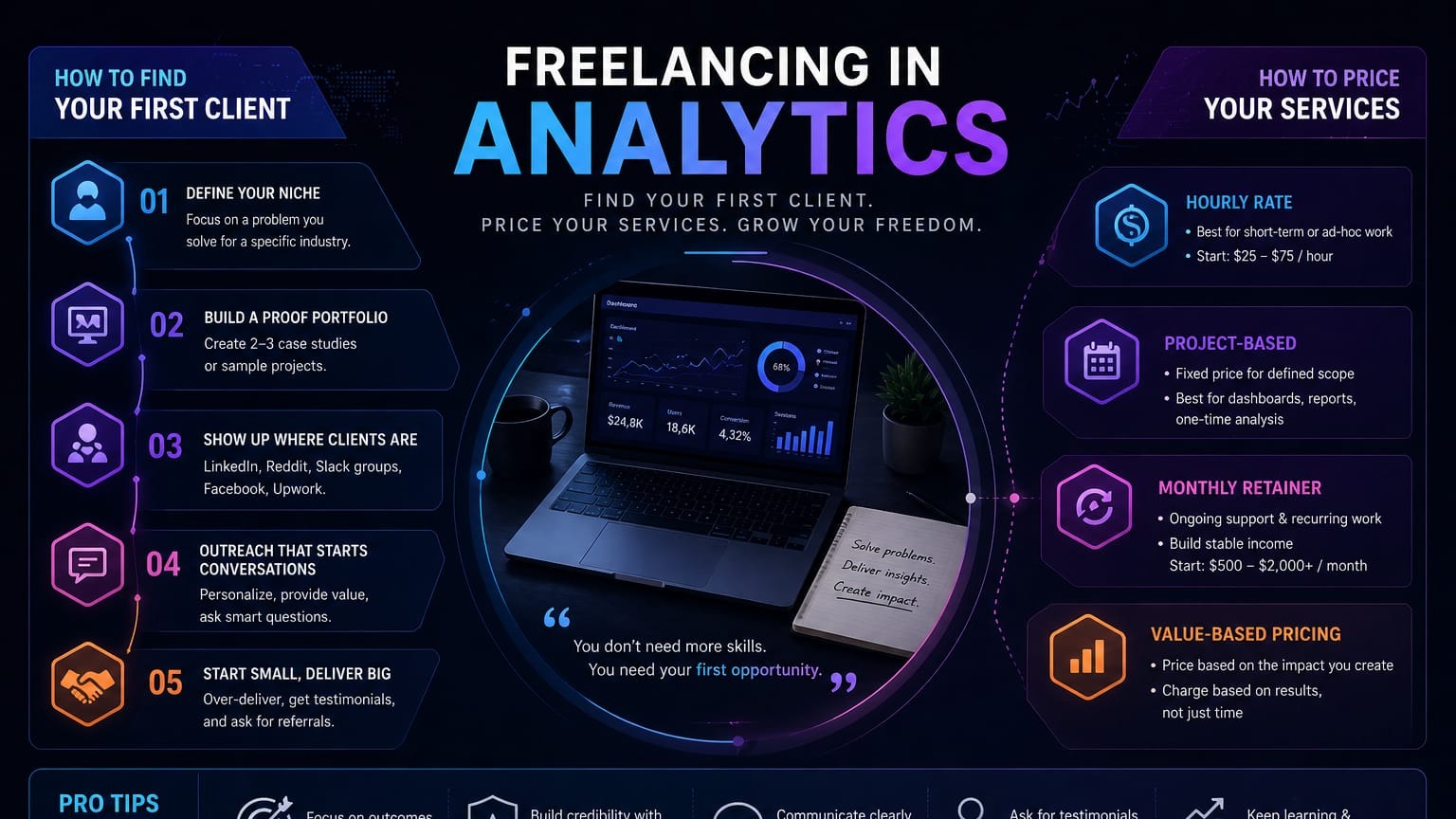
- Freelancing in Analytics: How to Find Your First Client and Price Your Services:
Freelancing in analytics is a great career option for people who know tools like Excel, SQL, Power BI, Python, and data visualization. Many beginners have the skills, but they get confused about two things:
- How to get the first client and how to decide pricing.
The best way is to move step by step:
- Step1: Understand what service you want to offer:
Before finding clients, first decide what kind of analytics service you want to provide. Do not keep it too broad. Instead of saying “I do analytics,” choose a specific service like:
- Excel dashboard creation
- Data cleaning and reporting
- Power BI dashboard development
- Sales data analysis
- KPI and Business report preparation
This makes your profile look more professional and helps clients quickly understand your work.
- Step2: Identify your target client:
Once your service is clear, decide who needs it.
Your first client can be:
- Small business owner
- Startups
- Shop owners
- Digital marketers
- E-commerce sellers
- Students or researchers needing data work
If you know your target audience, it becomes easier to approach the right people.
- Step3: Build a small portfolio:
Clients usually ask, “What work have you done before?”
So even if you do not have real clients yet, make sample projects.
For example, you can create:
- A sales dashboard in excel
- A Power BI report on business performance
- A customer data analysis project
- A cleaned dataset with visual insights
- A monthly sales trend report using python or excel
Your portfolio does not need to be very big. Even 2 to 3 good projects are enough in the beginning.
- Step4: Create your professional presence:
Now make yourself visible online. You can do this by creating:
- A strong LinkedIn profile
- A clean Resume
- A portfolio PDF or Google Drive folder
- Profiles on freelancing platforms like Upwork, Fiverr, Freelancer
Your profile should clearly mention:
- What service your provide
- Which tools you use
- What problems you solve
- What type of clients you help
Example:
“I help small businesses clean, analyze, and visualize their sales data using Excel and Power BI.”
- Step5: Start finding your first client:
Now begin client hunting. There are many ways to find your first client:
- Freelancing Platforms:
Create profiles on platforms like Upwork, Fiverr, and Freelancer. Apply for beginner-friendly analytics jobs.
- LinkedIn Networking:
Post your sample projects and tell people that you are available for freelance analytics work.
- Personal Network:
Tell your friends, teachers, seniors, relatives, and local businesses that you can help with reports, dashboards, and analysis.
- Direct Outreach:
Message small business owners or startups and politely explain how your analytics work can help them.
The first client often comes from networking or referrals because people trust known contacts more.
- Step6: Write a good client pitch:
When applying for work, do not only write about your tools. Focus on the client’s problem.
Instead of writing:
“I know Excel, SQL, and Power BI.”
Write like this:
“I can help you organize your sales data, build a clear dashboard, and show which products are performing best.”
A good pitch should include:
- What problem you understand
- How you will solve it
- Which result the client will get
- Why they should trust you
Keep it short, clear, and professional.
- Step7: Start with small projects:
As a beginner, do not chase only big clients. Start with smaller tasks such as:
- Cleaning Excel files
- Making charts and dashboards
- Writing SQL queries
- Preparing monthly reports
- Basic business data analysis
Small projects help you:
- Build Confidence
- Collect reviews and testimonials
- Improve communication with clients
- Understand real business problems
Your first goal is not only money. It is also to build trust and experience.
- Step8: Choose a pricing method:
Now comes the important part: pricing. Beginners often feel confused here. The easiest way is to choose one of these three methods:
- Hourly pricing:
Charge per hour of work. This is useful when the task is small or unclear.
- Project-based pricing:
Charge a fixed amount for the whole project, such as one dashboard or one report.
- Monthly retainer pricing:
Charge monthly when the client needs regular support, like weekly reports or monthly dashboard updates.
For beginners, hourly or project-based pricing is usually the best starting point.
- Step9: Decide your starting rate:
To decide your price, consider:
- Your skill level
- Time required
- Project complexity
- Value delivered to the client
For example:
- Basic Excel data cleaning = lower price
- Power BI dashboard with KPIs = higher price
- Full business analysis with recommendations = even higher price
As a beginner, keep your pricing fair and reasonable. Do not charge too low just because you are new. Very cheap pricing can make clients doubt your quality.
- Step10: Explain your price confidently:
When a client asks for your rate, do not feel shy. Explain what is included in your work.
For example:
“This project includes data cleaning, dashboard creation, insights, and two revisions, so my price is based on the full deliverable.”
Clients are more willing to pay when they understand the value of your work.
- Step11: Deliver quality work and ask for feedback:
After getting your first client, focus on:
- Submitting work on time
- Keeping communication clear
- Giving neat and professional reports
- Solving the client’s real problem
Once work is completed, ask for:
- A review
- A testimonial
- Permission to add the project to your portfolio
This helps you get your second and third client more easily.
- Step12: Increase your pricing gradually:
Do not stay at beginner pricing forever. After completing a few projects and getting positive reviews, slowly increase your rates.
You can increase pricing when:
- Your skills improve
- Your work quickly becomes stronger
- You start delivering better business values
- You have client testimonials and proof of result
This is how freelancing grows step by step.
- Common mistakes to avoid:
Many beginners make these mistakes:
- Offering too many services at once
- Charging too little
- Applying to random jobs without understanding the client’s need
- Not making a portfolio
- Writing weak proposals
- Ignoring communication skills
Avoiding these mistakes can help you grow faster.
- Conclusion:
Freelancing in analytics becomes easier when you follow a simple step-by-step process. First, choose your service. Then build a portfolio, create your online presence, find small clients, pitch clearly, and use a fair pricing model. Your first client may take time, but once you get started, each project helps you build trust, confidence, and better income.