
Introduction
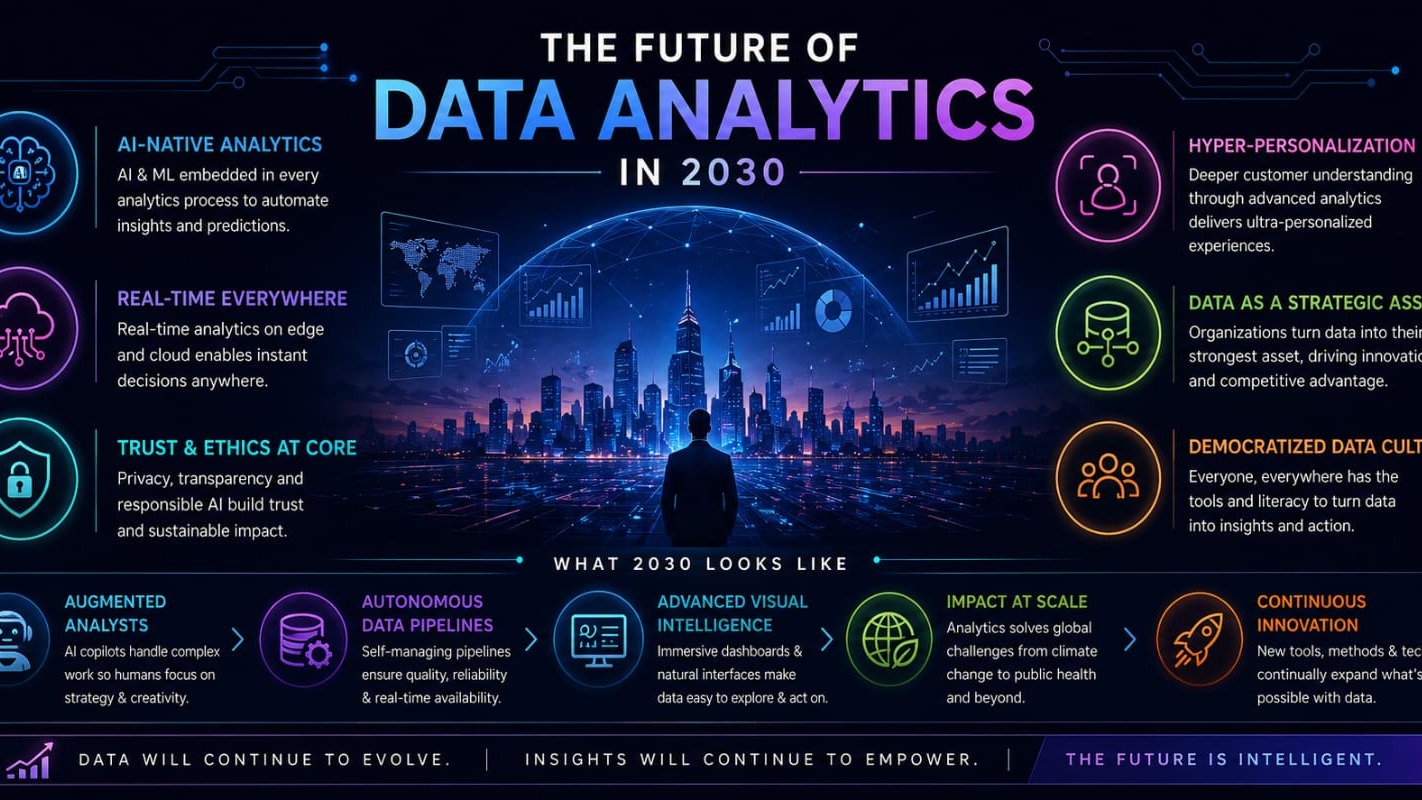
Data analytics has already transformed how businesses operate, but by 2030, it will become even more powerful, intelligent, and deeply integrated into everyday decision-making. With the rise of artificial intelligence (AI), real-time data processing, and advanced computing technologies, analytics will move from a support function to the core driver of strategy and innovation.
1. AI-Driven and Autonomous Analytics
By 2030, analytics will no longer rely heavily on human intervention. AI-powered systems will:
Automatically collect, clean, and analyze data
Identify patterns and anomalies in real time
Provide prescriptive recommendations, not just insights
This shift will reduce the gap between data collection and decision-making to almost zero.
In simple terms:
Businesses won’t just analyze data — they’ll act on it instantly.
2. Rise of Real-Time and Edge Analytics
The future is fast. Companies won’t wait hours or days for reports.
Real-time analytics will become the default
Edge computing will process data closer to the source (IoT devices, sensors, etc.)
Instant decision-making will improve industries like healthcare, finance, and logistics
This evolution is turning data into a live, continuously updating asset.
3. Natural Language and Conversational Analytics
By 2030, interacting with data will feel like talking to a human.
Instead of writing code or complex queries, users will simply ask:
“Why did sales drop last month?”
“Predict next quarter’s growth.”
Natural Language Processing (NLP) will make analytics accessible to non-technical users, democratizing data across organizations.
4. Quantum Computing and Advanced Processing
One of the biggest breakthroughs will be quantum computing.
Massive datasets will be processed in seconds
Complex simulations (finance, climate, supply chains) will become easier
Problems previously impossible to solve will become solvable
This will push analytics into a new era of extreme speed and capability.
5. Data as a Product & Monetization
Organizations will no longer treat data as a byproduct.
Instead, they will:
Package data into products and services
Build data marketplaces
Generate revenue directly from insights
This trend will turn data into a strategic business asset, not just an operational tool.
6. Growing Demand for Data Professionals
The demand for data-related roles will skyrocket.
Big Data Specialists expected to grow significantly by 2030 (The Times of India)
New hybrid roles combining analytics + business strategy
Greater need for AI, cloud, and data governance skills
But here’s the reality:
Pure technical skills won’t be enough anymore.
From real-world discussions:
“What’s becoming scarce is people who can translate analysis into decisions.”
The winners will be those who can connect data with real-world impact.
7. Ethical, Secure, and Governed Data Systems
As data grows, so do concerns:
Privacy and data protection
Bias in AI models
Responsible data usage
Organizations will need strong data governance frameworks to ensure trust and compliance.
8. Integration of Generative AI and Data Agents
Generative AI and intelligent agents will:
Build dashboards automatically
Generate reports and insights
Assist analysts like a “copilot”
These tools will move analytics from manual work to augmented intelligence, where humans and AI collaborate.
Conclusion
By 2030, data analytics will not just support decisions—it will drive them autonomously.
We are heading toward a world where:
Data is real-time and always available
AI handles complexity
Humans focus on strategy and judgment
Final Thought
If you’re planning your future:
Don’t just learn tools.
Learn how to:
Think critically
Understand business problems
Translate data into action
Because in 2030, the most valuable skill won’t be analyzing data—it will be making decisions with it.