
How Netflix Uses Data Analysis for Recommendations: A Simple and Engaging Guide
Have you ever opened Netflix and felt like it just knows what you want to watch next? Whether it’s suggesting a binge-worthy series, a movie you didn’t know you’d love, or even showing the perfect thumbnail — that’s not magic. It’s data analysis working behind the scenes.
In this blog, let’s break down how Netflix uses data analysis in a simple, human way so you can understand the smart system behind your screen.
The Power of Data in Netflix
Netflix is not just a streaming platform — it’s a data-driven company. Every action you take on Netflix creates data. This includes:
What you watch
How long you watch
When you pause or stop
What you search for
What you skip
Your ratings (thumbs up/down)
Even the time you spend browsing matters.
Netflix collects all this information to understand your behavior and preferences. This data becomes the foundation for its recommendation system.
Step 1: Understanding User Behavior
Netflix’s first goal is simple: understand you better.
Let’s say:
You watch a lot of romantic movies
You finish series quickly
You prefer content in Hindi
Netflix notes all these patterns.
Instead of asking you directly what you like, Netflix observes your actions. This is more accurate because sometimes we don’t even know what we like until we see it.
Step 2: Grouping Similar Users (Clustering)
Once Netflix has your data, it doesn’t stop there. It compares you with millions of other users.
Using a technique called clustering, Netflix groups people with similar behavior.
For example:
Users who like crime thrillers and dark shows
Users who enjoy comedy and light content
Users who prefer regional or international content
If someone in your group watches a show and loves it, Netflix may recommend that show to you as well.
This is called collaborative filtering — “people like you also watched this.”
Step 3: Content Tagging (Metadata Analysis)
Netflix doesn’t just analyze users — it also deeply analyzes content.
Every movie or show on Netflix is tagged with hundreds of details, such as:
Genre (comedy, thriller, drama)
Mood (dark, emotional, funny)
Pace (slow, fast)
Actors and directors
Language
Themes (revenge, love, friendship)
This tagging process is known as metadata analysis.
For example, instead of just labeling something as a “romantic movie,” Netflix may tag it as:
“slow-paced emotional romantic drama with a tragic ending”
This helps Netflix match content more accurately with your taste.
Step 4: Personalized Recommendation System
Now comes the main part — recommendations.
Netflix combines:
Your behavior
Similar users’ behavior
Content metadata
Using machine learning algorithms, it predicts what you are most likely to watch next.
This is why:
Your homepage looks different from someone else’s
Even the order of shows is personalized
You see “Because you watched…” suggestions
Netflix is constantly updating these recommendations based on your latest activity.
Step 5: A/B Testing (Experimenting with You)
Netflix doesn’t assume it’s always right. It tests everything.
This is done using A/B testing, where different users see different versions of the same feature.
For example:
Two different thumbnails for the same movie
Different recommendation lists
Different layouts
Netflix analyzes which version gets more clicks and engagement.
If a certain thumbnail makes more people click, Netflix uses it more widely.
Step 6: The Role of Machine Learning
At the heart of Netflix’s system is machine learning (ML).
Machine learning models:
Learn from past data
Identify patterns
Improve predictions over time
For example:
If you start watching more documentaries, Netflix quickly adapts
If you suddenly switch genres, recommendations change
This makes the system dynamic and personalized.
Step 7: The Importance of Watch Time
Netflix’s main goal is not just clicks — it’s watch time.
They measure:
How long you watch
Whether you complete a show
Whether you binge-watch
If many users stop watching a show midway, Netflix understands that the content may not be engaging.
This data helps Netflix:
Improve recommendations
Decide what kind of content to produce
Step 8: Data-Driven Content Creation
One of the most interesting uses of data analysis is in creating new content.
Netflix doesn’t just recommend shows — it also decides what shows to make.
For example:
If data shows users love political dramas + a certain actor
Netflix may create a show combining both
A famous example is House of Cards, which was produced based on user data showing interest in:
Political dramas
Director David Fincher
Actor Kevin Spacey
This reduces risk and increases chances of success.
Step 9: Personalization Beyond Recommendations
Netflix goes beyond just suggesting shows.
It personalizes:
Thumbnails (you may see a different image than others)
Trailers
Search results
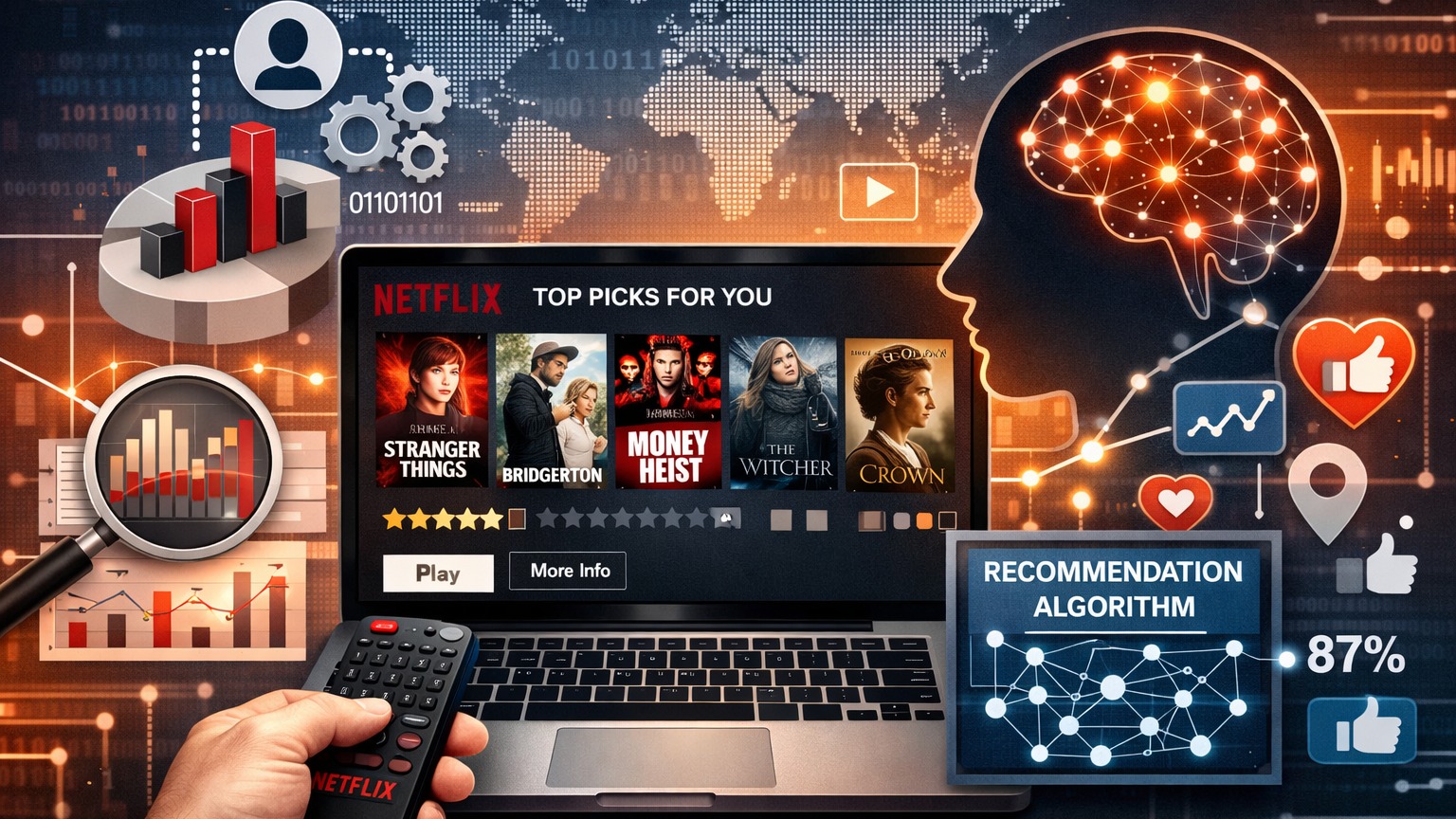
Categories (e.g., “Top picks for you”)
For example:
If you like action, Netflix may show an action-packed thumbnail for the same movie
If you like romance, it may show a romantic scene
Same content, different presentation — based on your taste.
Step 10: Continuous Improvement
Netflix’s system is always learning.
Every time you:
Watch something
Skip something
Rate something
The system updates your profile.
This means your recommendations keep improving over time.
Challenges in Netflix Data Analysis
Even with advanced systems, Netflix faces challenges:
1. New Users (Cold Start Problem)
When a new user joins, there’s no data. Netflix solves this by:
Asking preferences initially
Showing popular content
2. Changing Preferences
Your taste may change over time. Netflix handles this by:
Giving more weight to recent activity
3. Too Many Choices
Netflix must avoid overwhelming users. So it:
Shows limited, curated recommendations
Why Netflix’s Data Strategy Works
Netflix’s success comes from a few key principles:
User-focused approach – Everything is about improving user experience
Continuous learning – The system keeps evolving
Smart use of data – Not just collecting data, but using it effectively
Personalization – Every user feels the platform is built just for them
Conclusion
Netflix’s recommendation system is a perfect example of how powerful data analysis can be when used correctly. It combines user behavior, machine learning, content analysis, and continuous testing to create a highly personalized experience.
The next time Netflix suggests a show that you end up loving, remember — it’s not luck. It’s the result of millions of data points, smart algorithms, and constant improvement.
In simple words, Netflix doesn’t just stream content — it understands you.
And that’s the real reason why we keep coming back for “just one more episode.”